
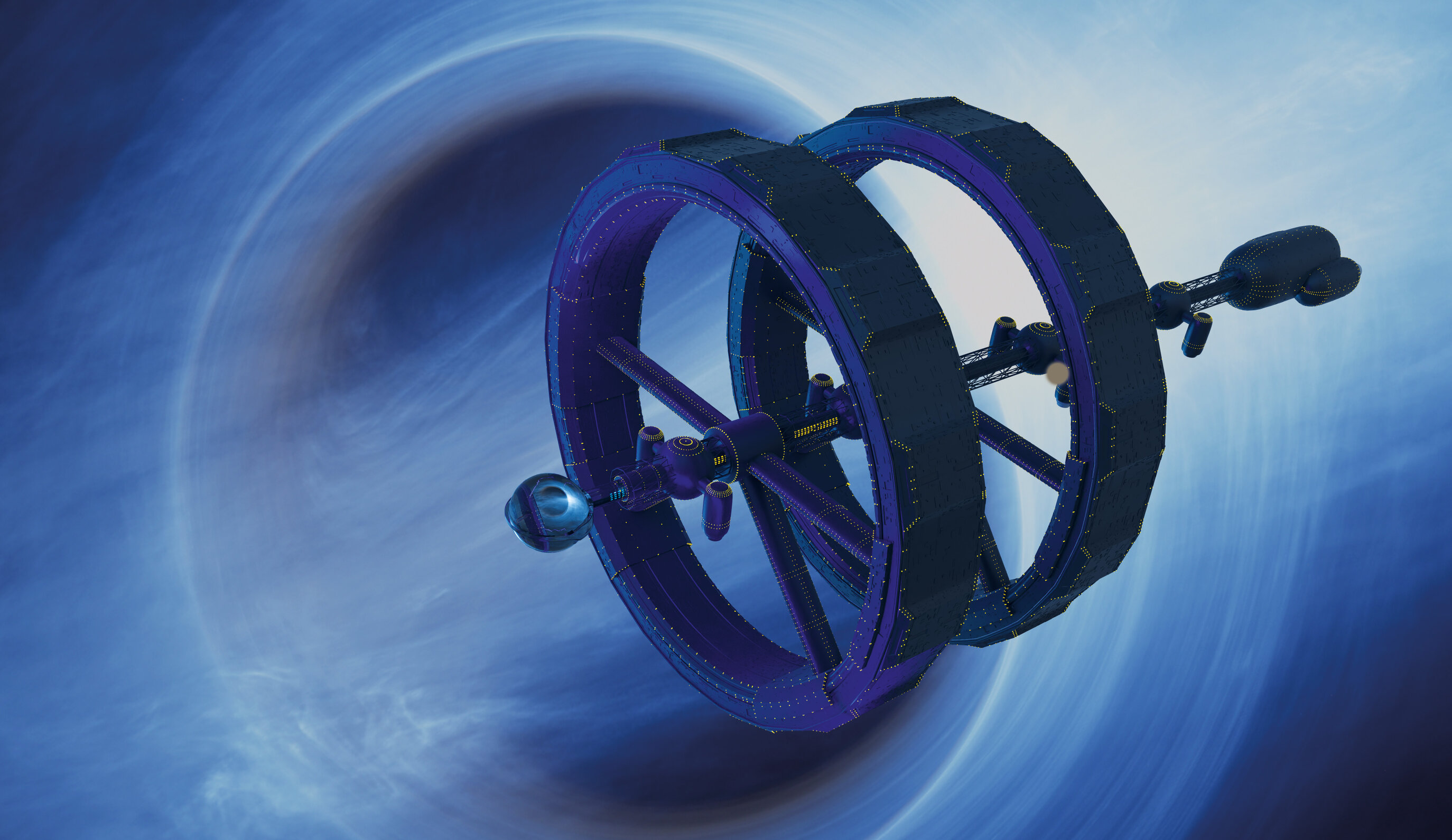
Destination: Black Hole
Experience an extraordinary journey through the universe: by the year 2125, space tourism will have long been a reality – and the most spectacular destination is the black hole at the centre of our Milky Way: Sagittarius A*.
On board of an interstellar spacecraft, you’ll set off on a journey to this cosmic giant. Accompanied by an experienced pilot and a highly advanced artificial intelligence, you’ll uncover the secrets of black holes and witness the dramatic processes unfolding at the centre of our galaxy.
On your journey, you’ll approach the most extreme regions of the universe and learn how gravity alters space and time itself. What lies behind a singularity? And how do the colossal black holes at the heart of galaxies form?
But be warned: Not everything near the galactic centre is predictable…
‘Destination: Black Hole’ takes you on an immersive 360° expedition to one of the most fascinating and enigmatic objects in the universe – an adventure combining science, imagination and cosmic discovery.
| Recommended minimum age (in years) | 10 |
|---|---|
| Duration | 45 minutes (including a 15-minute live segment in German) |
| Language | German |
| Translation | Simultaneously translated into French, Italian and English (headphones) |
| Doors open | 10 minutes before the start. The show starts on time. No admission will be permitted once the show has started. To be on the safe side, please allow 20 minutes for buying tickets and making your way to the planetarium. |
Q&A
What is Sagittarius A*?
Sagittarius A* (Sgr A* for short) is a supermassive black hole at the centre of our Milky Way. It is situated approximately 26,000 light-years from Earth in the constellation Sagittarius.
Why is Sagittarius A* a black hole?
Its enormous mass is concentrated within an extremely small space. As a result, gravity is so strong that, beyond a certain point – the event horizon – not even light can escape.
Can you see black holes?
No. A black hole itself does not emit any visible light. However, scientists can study it indirectly, for example by observing the movements of stars and gas in its vicinity.
In 2022, the Event Horizon Telescope (EHT) published the first image of the immediate surroundings of Sagittarius A*. What can be seen is not the black hole itself, but the glowing gas around the dark region created by the black hole’s shadow.
How big is Sagittarius A*?
Sagittarius A* has a mass of approximately 4.3 million solar masses. Its event horizon has a diameter of about 25 million kilometres.
What happens in the vicinity of a black hole?
The surrounding area contains stars, gas and dust. Matter can be accelerated and heated by the strong gravitational pull, emitting intense radiation in the process.
Is Sagittarius A* a danger to Earth?
No. Earth is about 26,000 light-years away and is at a safe distance. Sagittarius A* does not simply pull everything from the entire Milky Way towards itself.
Are there many other black holes?
Yes. Observations show that the centres of a great many large galaxies contain supermassive black holes. Some are even billions of times as massive as our Sun.