
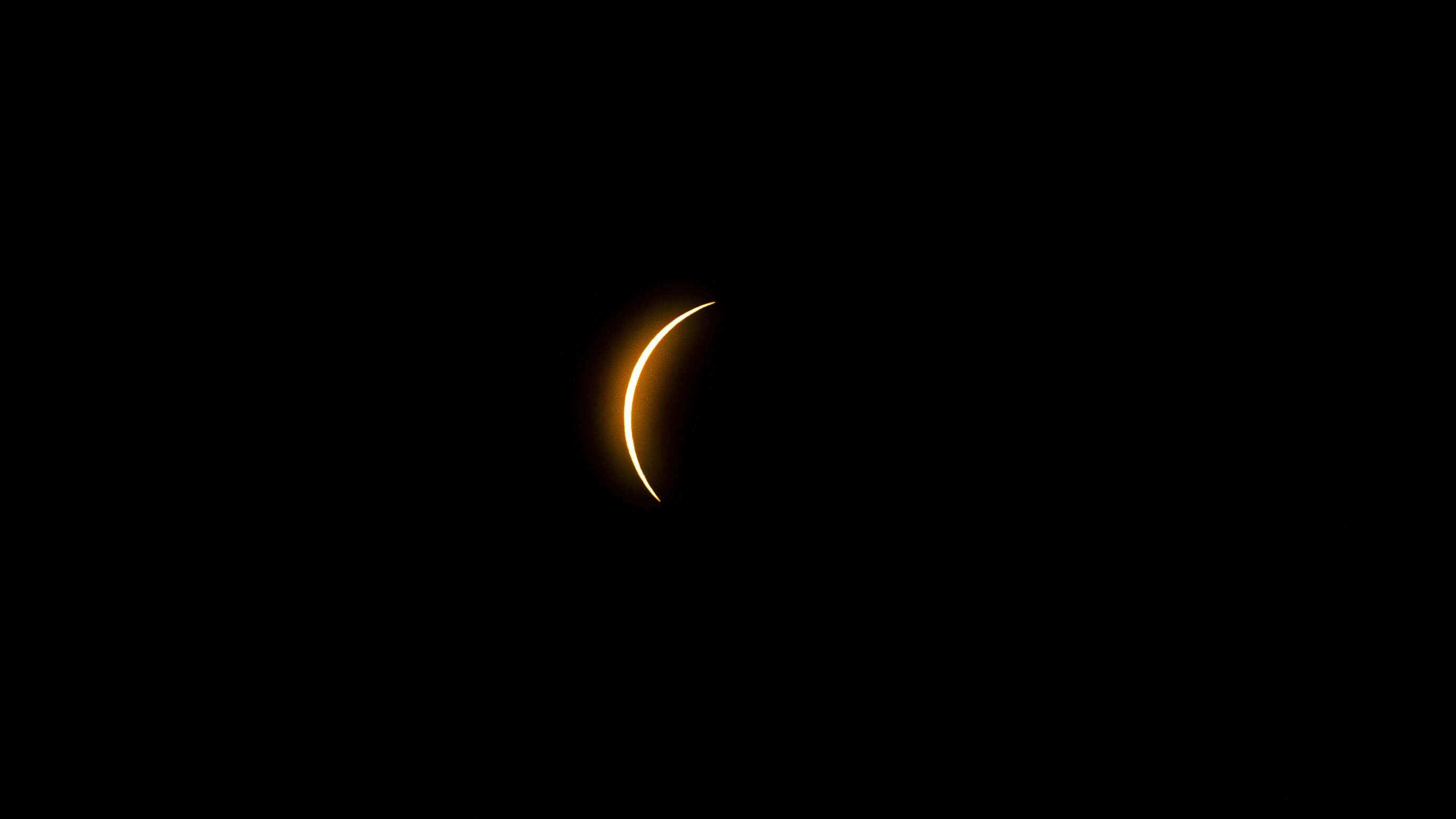
Solar eclipse – When the Moon blocks out the Sun
It’s a celestial event you won’t forget easily – a solar eclipse!
The Moon moves in front of the Sun and the sky suddenly grows dim. For a few minutes, it feels as though night is falling in the middle of the day. Nature falls silent and a night-time stillness descends. Yet this spectacle is so rare that many people will never experience it.
Why is that, and what actually happens during a solar eclipse?
Our Moon orbits the Earth in 27.3 days. As it orbits, we can observe the Moon’s different phases.
However, due to the Earth’s simultaneous movement around the Sun, a complete cycle of the Moon’s phases takes about 29.5 days. The phases occur because, from Earth, we see different proportions of the Moon’s surface illuminated by the Sun.
At the new moon, the illuminated side is turned away from Earth; at the full moon, we see it in its entirety. In between lie the waxing and waning crescent and half-moon phases.
When the Moon is in the new moon phase and aligned with the Earth and the Sun, it obscures the Sun and its shadow falls upon the Earth’s surface.
In the moon’s shadow, we experience a solar eclipse.
But why isn’t there a solar eclipse every time there is a new moon?

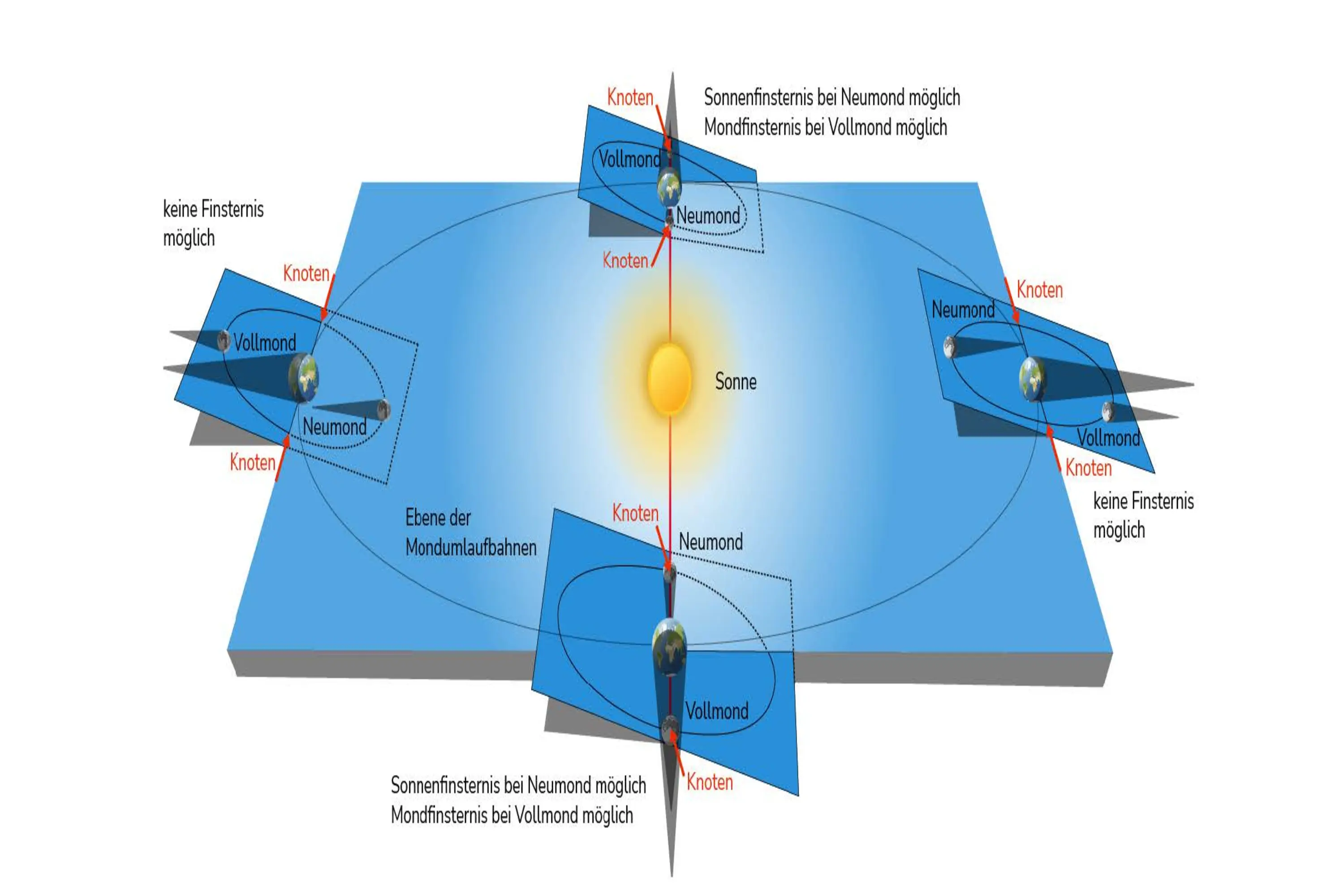
Whilst the Moon orbits the Earth, the Earth simultaneously orbits the Sun over the course of a year. The Moon’s orbit is inclined by approximately 5° relative to that of the Earth, meaning that there are only two points at which the Earth, Moon and Sun are aligned with one another – the points of intersection of these planes.
The Moon must therefore be at one of the two nodes during the new moon phase in order to cast a shadow onto the Earth. The shadow itself does not cover the entire globe. It traces a path across the Earth’s surface, known as the path of totality.
So if the Moon is not positioned exactly at one of the two nodes, or if you are in an unsuitable location on Earth outside the path of totality, you will, at best, only experience a partial solar eclipse.
Another factor is the Moon itself, as it is not always the same distance from us as it orbits the Earth. Its orbit is elliptical, which means that our satellite is sometimes closer and sometimes further away.
If, during a solar eclipse, the Moon is near its apogee – the point in its orbit furthest from Earth – it appears slightly smaller in the sky, cannot cover the entire Sun, and a bright ring of sunlight remains visible around the Moon’s shadow. This is known as an annular, or ring-shaped, solar eclipse. (Image by Spaceaero2, CC BY-SA 3.0 via Wikimedia Commons)
There are therefore a number of conditions that must be met for a total solar eclipse to be visible. As a result, this celestial spectacle is a rare sight.
The last total solar eclipse visible from Switzerland took place over 300 years ago, on 22 May 1724. Anyone wishing to witness the next one will have to wait until 3 September 2081. A truly once-in-a-century event.

The partial solar eclipse on 12 August 2026 was also very impressive due to the high degree of coverage
and comparable to the event in 1999. The next time the Moon will pass in front of the Sun for us in Switzerland will be on 2 August 2027 – but this time with an occultation of only about 56 per cent!
Author

Dorothea Holzschuh
Teamleader Planetarium