
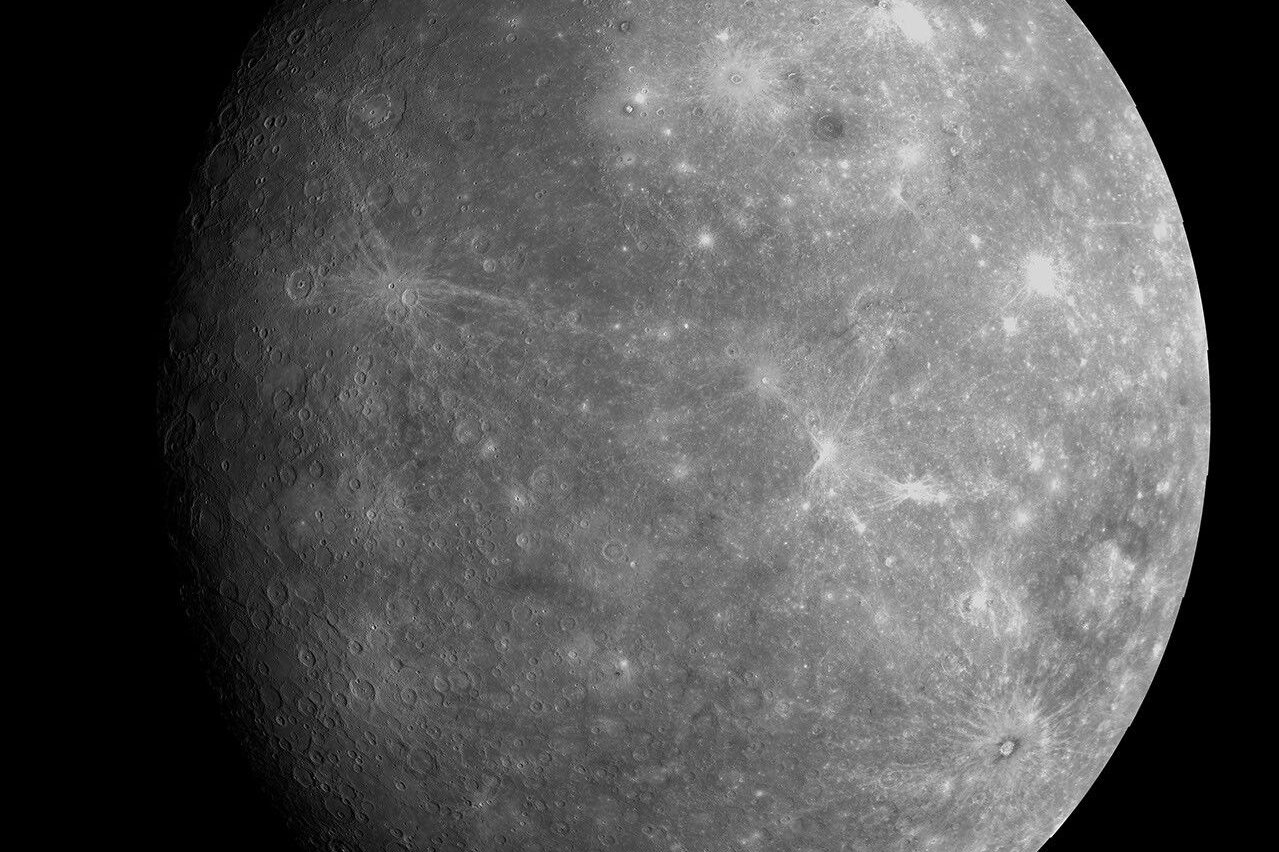
Final push towards Mercury – BepiColombo nears its destination
The journey of the European-Japanese space probe BepiColombo to the most extreme planet in our solar system took almost eight years. On 21 November 2026, it is finally due to enter orbit around Mercury, the smallest planet and the one closest to the Sun.
This text was produced as part of a science communication internship at the planetarium.
Status 29 September 2026. Images ©ESA. Authors: Marie-Alix Bobrich & Dorothea Holzschuh.
What is BepiColombo?
BepiColombo is a joint mission between ESA and the Japanese space agency JAXA. Its destination is Mercury, the smallest and closest planet to the Sun in our solar system and the least explored terrestrial planet; due to its proximity to our star, it occupies an extreme position amongst the planets.
The spacecraft comprises a trio of instruments: the European MPO (Mercury Planetary Orbiter), the Japanese Mio (originally known as the ‘Mercury Magnetospheric Orbiter’, or MMO for short) and the MTM transfer stage developed by ESA. During the journey to Mercury, the two orbiters were mounted on the MTM. It is rare for two probes to be sent to their destination together. In this case, however, the MPO and Mio are intended to complement each other’s work. The MPO focuses on the surface characteristics and internal composition of the planet, whilst Mio is designed to study Mercury’s magnetic field.

Why is the mission so exciting?
Mercury has so far been little studied at close range. Only NASA’s Mariner 10 (launched in 1973) and Messenger (launched in 2004, in Mercury’s orbit from 2011 to 2015) space probes have provided us with more detailed data on the planet. The rarity of such visits is due to the high temperatures and harsh conditions. Furthermore, because of its proximity to the Sun, it is very difficult to send probes to Mercury that can survive these conditions and be accelerated to Mercury’s orbital speed.


The physics of the swing-by manoeuvre
Using a planet’s gravitational field in space missions is a sensible way of significantly slowing down the high velocity that the probe has after launch, as in the case of BepiColombo. In space, spacecrafts rely on their engines to accelerate, decelerate or change direction. However, if a probe flies close to a planet, it can use the planet’s gravitational pull to adjust its direction and speed without using any of its own fuel. This has a major advantage, because if a spacecraft can utilise a planet’s gravitational field, it requires less fuel on board and can therefore carry more scientific payload.
One and a half years after launch, BepiColombo carried out its first swing-by manoeuvre around Earth (picture on the left), followed by two more around Venus and six around Mercury. In the process, it travelled around 9.9 billion kilometres and lost over 3,000 km/s in speed.

What is happening now
On 3 September 2026, the MTM transfer module, which had carried the two probes, MPO and Mio, was detached. The two probes are expected to enter orbit around Mercury together on 21 November 2026 and separate between 9 and 10 December 2026 to reach their own orbits. April 2027 marks the start of the scientific mission, during which the orbiters will collect comprehensive scientific data on Mercury.

The science behind BepiColombo
As soon as BepiColombo reaches Mercury, the investigations will begin. The MPO is set to use its cameras to map the surface in greater detail than ever before, whilst a high-precision laser altimeter will provide supplementary elevation data. By analysing all this data, researchers hope to gain insights into Mercury’s geological and chemical composition. This includes determining whether the planet’s core is liquid or solid. Mio is set to investigate the magnetic field and its interaction with the solar wind. The space probes are intended to shed more light on the formation and evolution of the inner planets, including Earth. Furthermore, current research suggests that Mercury appears to be shrinking. Is this a typical phenomenon for a planet, or is it simply a peculiarity of Mercury?

Current challenges
Before all these questions can be answered, however, BepiColombo still has to overcome a number of major challenges. The first is to ensure that the probe enters orbit around Mercury despite the Sun’s strong gravitational pull, rather than crashing into the Sun. In addition, the solar panels must be aligned at exactly the right angle to the Sun so that they capture enough sunlight to meet the high energy demands of the propulsion system. At the same time, however, they must not be exposed to too much sunlight, as solar radiation near Mercury is around ten times stronger than on Earth and the panels could overheat.
A little piece of Switzerland at Mercury
Switzerland is also involved in the BepiColombo mission. On board the MPO is the previously mentioned laser altimeter BELA (BepiColombo Laser Altimeter), which was developed under the leadership of the University of Bern. It is the first laser altimeter built in Europe for interplanetary flights. From an altitude of around 1,000 kilometres, BELA can measure the surface of Mercury with an accuracy of less than one metre.

Keep your fingers crossed on 21 November
The most exciting moment of the mission is yet to come.
The manoeuvre to enter Mercury’s orbit involves a single, pre-programmed engine burn. As a radio signal takes around 11 minutes to travel from Mercury to Earth, the control centre in Darmstadt can no longer intervene and can only wait to see if everything goes as planned.
We’re keeping our fingers crossed for BepiColombo and can’t wait to see the first images and data from the innermost planet in our solar system!
Contact person

Dorothea Holzschuh
Teamleader Planetarium