
A comet armada and a "mysterious" interstellar object
Astronomers have been following the interstellar object 3I/ATLAS, which turns out to be a comet, for some time now and is the subject of many an adventurous story, especially on various social media channels. However, the upcoming month of October could well be an exciting month for comets, as C/2025 R2 SWAN is already showing a 5° long tail.
Fuelled in part by the Israeli-American theoretical astrophysicist Avi Loeb, who teaches as a professor at Harvard University and is known to focus on the search for extraterrestrial life, an increasing number of almost adventurous stories about the third interstellar object to be discovered, 3I/ATLAS, have been circulating in recent months. Images of the "flying cigar" 1I/ʻOumuamua were immediately brought out, as such an elongated shape had never been seen before. Even then, Loeb made the bold assumption that the interstellar lump could be of "artificial origin", an extremely controversial hypothesis in scientific circles. It's no wonder that such statements are spreading like wildfire on various channels these days. Everyone who sees themselves as a "scientist" believes they have to post something about it, because after all, something "extraterrestrial" sells particularly well and generates a lot of clickbait.
Hardly anyone is interested in "normal" things
It can be assumed that various interstellar objects beyond the Kuiper Belt have already travelled through our inner solar system, even though only two such objects were discovered before, 1IʻOumuamuaand 2I/Borisov. The technical possibilities did not exist 30 or more years ago. Only in recent decades have automatic asteroid search systems such as Near-Earth Objects (NEOs), NEOWISE, Pan-STARRS or the "Asteroid Terrestrial-impact Last Alert System" (ATLAS) been developed; before that, we had to rely on visual observations by professional astronomers or amateur astronomers. Accidental discoveries were a minor sensation. Today, comets usually "only" bear the names of such search systems. There are now dozens of "NEOWISE", "ATLAS" or "Pan-STARRS" and only rarely a comet that bears the name of its honest "human discoverer" .
Back to 3I/ATLAS: Of course, unlike comets that find their way to us from the Kuiper Belt or the Oort Cloud, this object has a completely different orbit. Interstellar objects have the characteristic that they pass our sun once, i.e. they emerge from interstellar space and disappear into it again. Comets from the Oort Cloud can also be one-off guests, while long-period comets pass our central star again every few hundred years on wide elliptical orbits.
As we currently know very little about the origin of interstellar objects and do not fully understand their composition, they are of particular interest to scientists and give rise to speculation. Everything that is new and "unknown" - this is probably in our genes - stimulates our imagination. We at ORION take a sober and unagitated view of 3I/Atlas.

A brief history of 3I/Atlas
The cosmic chunk was discovered on 1 July 2025 by the ATLAS early warning system. At the time, it was only just under 18th magnitude, and just a few days after its sighting it was clear that this object would move towards us on a hyperbolic orbit between the orbits of Earth and Mars. Astronomers initially assumed that it was an asteroid, which is also revealed by its first name C/2025 N1 (ATLAS) , but in the weeks that followed, a coma developed around the solid body, the size of which is still a mystery today - the Hubble Space Telescope assumes it to be between 0.6 and 5.6 kilometres - which means that it is now clearly a comet. It now also shows a clearly visible tail in photos. As 3I/ATLAS will be unfavourably "behind" the sun for a longer period at the end of September/beginning of October, it will not delight us again in the morning sky until November. On 29 October, it will pass the sun at a distance of 203 million km and will not come closest to Earth until 19 December, albeit with a "safety distance" of 269 million km.
Even though it was recently possible to photograph 3I/ATLAS with an amateur telescope for the first time, the interstellar object will not be visible to the naked eye at any time. Its distance from Earth is far too great, even if its surface heats up close to the sun and bursts of brightness can occur, as happened recently. It is uncertain whether the chunk will survive its flyby of the sun unscathed. When it finally becomes visible again in November, astronomers expect a visual brightness of around 12 magnitudes. This is far beyond what we can see with our unaided eyes and is rather unspectacular even in a telescope.
So far, 3I/ATLAS has already shown us one or two special features. The object is travelling fast and stands out due to its high concentration of carbon dioxide. With "normal" comets, water vapour dominates. The greenish colour comes from molecules such as dicarbon, which fluoresce in sunlight.
Comet C/2025 R2 (SWAN) could surprise
Another comet named C/2025 R2 (SWAN) passed by the sun at a distance of 75 million km on 12 September and will come within 39 million km of the Earth on 19 October 2025.
Just a few days after the total lunar eclipse, a new comet was discovered using images from the Solar Wind Anisotropies (SWAN) instrument on board the SOHO space probe. The discovery was made by Ukrainian amateur astronomer Vladimir Bezugly, who observed the comet in the SWAN field of view. It is currently already showing a brightness of between +7.0mag and +6.5mag and a spectacular tail of a good 5° in length. The best view is currently from the southern hemisphere, but observers in the northern hemisphere will also be able to see it in October.
According to initial calculations, C/2025 R2 SWAN is a non-periodic comet with an orbital period of 20,000 years. It is currently already between 7th and 6th magnitude and has a spectacular tail of a good 5° in length. The best view is currently from the southern hemisphere, but observers in the northern hemisphere will also be able to see it in October.
With a bit of luck, it could reach a visual brightness of +4.0 mag at the time of its closest approach to Earth. At the very least, it will be a beautiful object for binoculars, but surprises are always possible with comets.
It only appears in the northern hemisphere after its perihelion. The comet has already formed a striking, slightly greenish ion tail. It is conceivable that C/2025 R2 SWAN will become even brighter as it approaches Earth. After all, it will pass us at a distance of 0.261 AU.
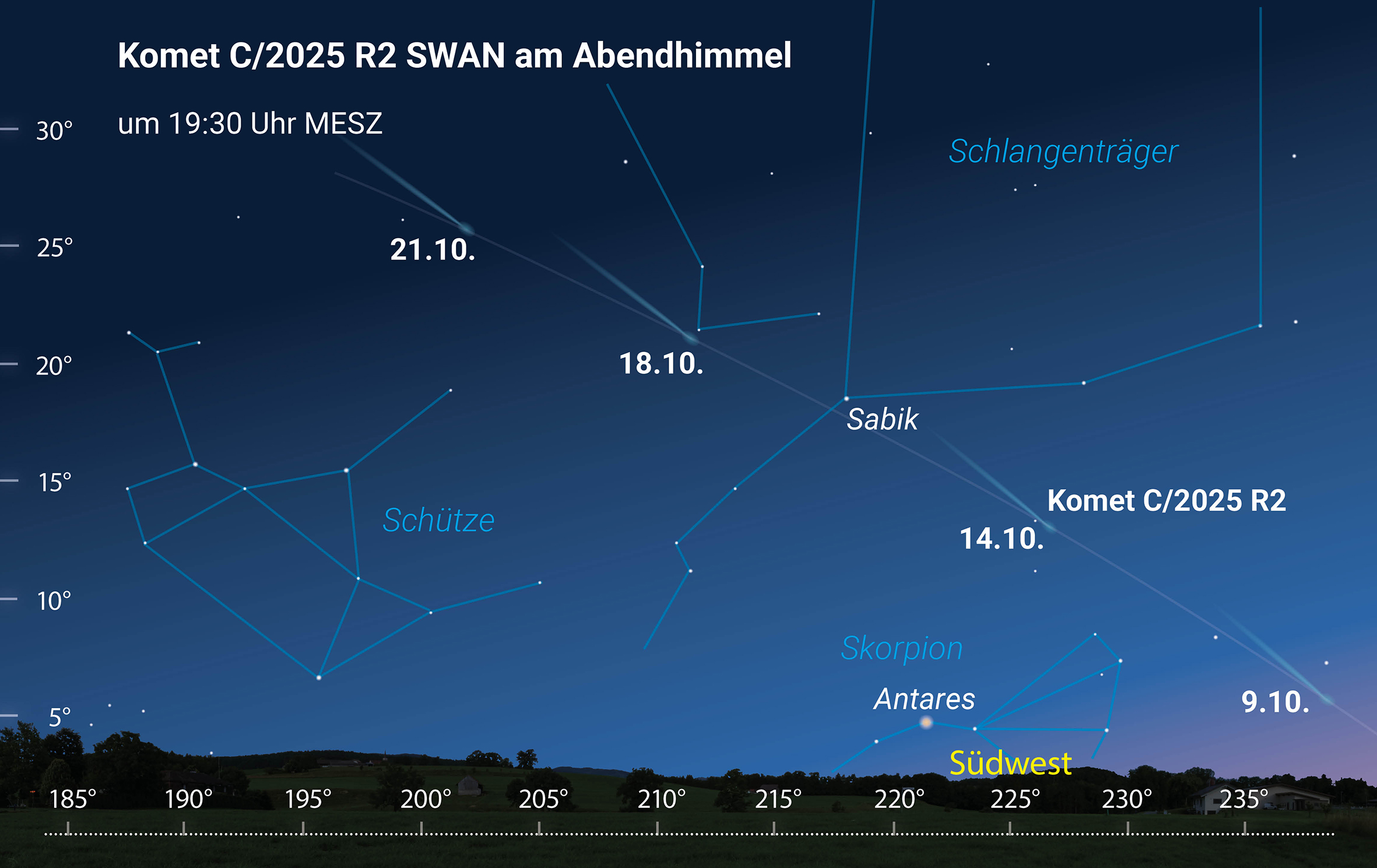
It passed Spica in Virgo on 15 September and the planet Mars on the 20th. However, this will not be observable as the Sun is currently passing through Virgo. On 28 September, it will enter Libra and cross the ecliptic northwards. The best observation phase in the northern hemisphere will be in October, when C/2025 R2 SWAN slowly rises low on the southwestern horizon. On 2 October, it passes the star Zubenelgenubi and rises ever higher into the Serpent Bearer over the following days. On 14 October, it encounters the +2.5mag bright star Sabik and passes M16 and M17 four days later.
If the comet remains intact, it could become a spectacular target for skywatchers and astrophotographers. Some optimistic predictions suggest that it could brighten to fourth magnitude, which would make it visible to the naked eye in dark skies. In addition, the Earth could pass through the comet's debris stream from 4 to 6 October. If this happens, we could experience a brand new meteor shower!
On 3 November, the comet will cross the celestial equator northwards and begin its long journey back into the outer solar system. It will gradually disappear from view until its next return.
What does the name "C/2025 R2 SWAN" mean?
The name of the comet contains information about its type, its discovery date and its discoverer:
- The letter "C" indicates a non-periodic comet. Such comets either pass through the solar system only once or take more than 200 years to orbit the sun.
- The designation "2025 R2" indicates that the comet was discovered in the first half of September 2025 and was the second comet discovered during this period.
- "SWAN" means that the discovery was made with the astronomical instrument Solar Wind Anisotropies (SWAN).
Not the only comet in October
Comet C/2025 R2 (SWAN) is not the only visitor to grace our skies in October 2025. Comet C/2025 K1 (ATLAS) could become visible through binoculars at the beginning of the month, while C/2025 A6 (Lemmon) could become brighter later. With three bright comets, October promises to be an exciting month for skywatchers.