The new Swiss Museum of Transport astroblog brings you the latest discoveries, exciting background stories and exclusive insights into the world of astronomy - understandable, inspiring and always close to the pulse of the cosmos.
The journey of the European-Japanese space probe BepiColombo to the most extreme planet in our solar system took almost eight years. On 21 November 2026, it is finally due to enter orbit around Mercury, the smallest planet and the one closest to the…
It’s a celestial event you won’t forget easily – a solar eclipse! The Moon moves in front of the Sun and the sky suddenly grows dim. For a few minutes, it feels as though night is falling in the middle of the day. Nature falls silent and a…
After the Apollo 17 mission left the Moon in 1972, it was to take almost 54 years before humankind returned to our satellite. But now the time has come!
On 6 October 1995, the Swiss astrophysicist Michel Mayor and his then Swiss doctoral student Didier Queloz from the University of Geneva announced the discovery of the first planet around another star!
In addition to the sun and the eight planets, our solar system is also home to many different astronomical small bodies. However, some of these objects do not primarily orbit the sun, but have an orbit around a planet. This is called a moon!
Every year, we look forward to the first warming rays of sunshine in spring, cool water in midsummer, but also the colorful sea of leaves in autumn or the first snowflakes in winter. But how are these seasons created?
Our neighboring planet Mars is widely known as the red planet. This color alone tells us a lot about the past of the second smallest planet in our solar system.
Almost 100 years ago, mankind began to proclaim its existence in space.
In Part 1 of the series we already learned about the SETI project and the Arecibo message, but mankind also sent physical messages on space probes into the vastness of space.
No astronomical object divides society and stirs up emotions like Pluto, which has not been counted as a planet for almost two decades.
Just a few days before man first set foot on the moon, Switzerland's first planetarium went into operation at the Swiss Museum of Transport on July 1, 1969.
Interview with Marc Horat on the inclusion of planetariums in the UNESCO Intangible Cultural Heritage List.
Three missions have arrived at Mars in the past few weeks. This shows that The Red Planet has lost none of its fascination.
"Planetarium LIVE" is one of the most popular show formats under the dome of the Lucerne Planetarium. Behind it are huge amounts of data that can be presented to our audience in real time using the space simulator. The interactive LIVE presentations…
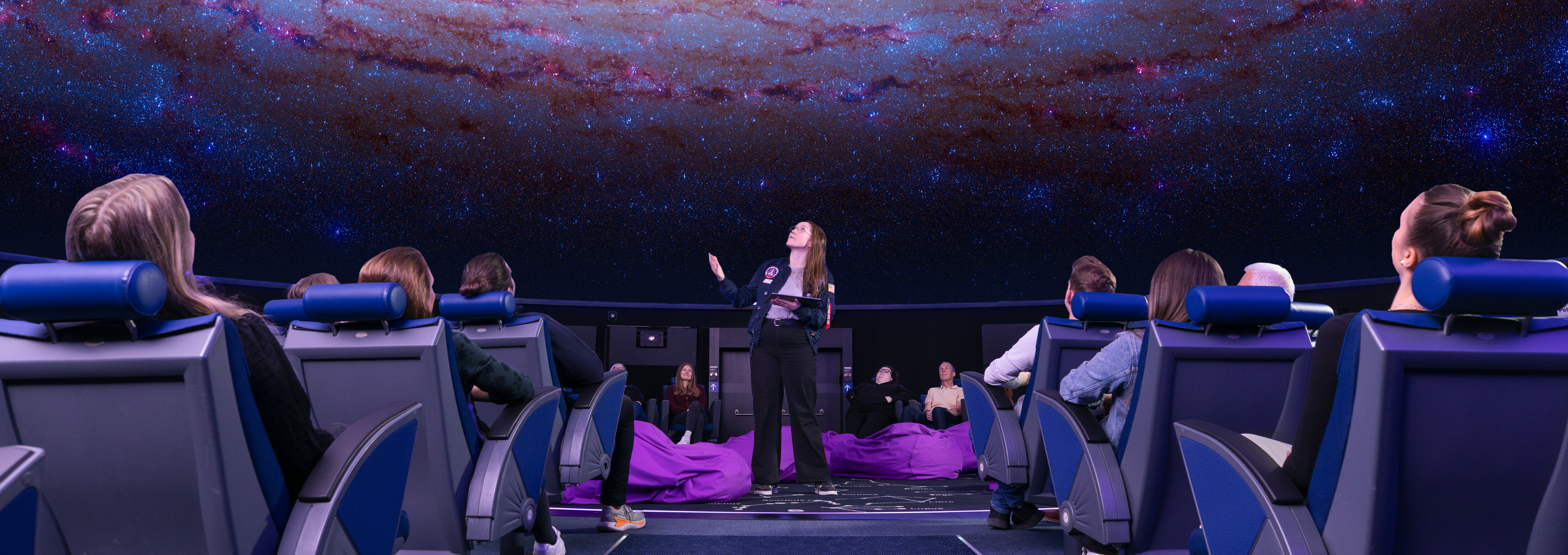
Modern planetariums like the one at the Swiss Museum of Transport are no longer just star theaters.
It had been less than a year since the US astronauts Armstrong and Aldrin had been the first humans to set foot on the moon as part of the Apollo 11 mission. Interest had already waned when James Lovell, John Swigert and Fred Haise set off on Apollo…
Our planetarium enjoys a world-renowned reputation - so it's all the better that we now have a visitor from Copenhagen: Søren from the Copenhagen Planetarium is visiting us this week to find out about our latest developments and exchange ideas with…
In 1995, the then still young astrophysicist Didier Queloz, together with Michel Mayor, made a scientific discovery of historic significance: for the first time, a planet orbiting a star outside our solar system was detected. This pioneering…
Astronomers have been following the interstellar object 3I/ATLAS, which turns out to be a comet, for some time now and is the subject of many an adventurous story, especially on various social media channels. However, the upcoming month of October…
Last 23 March, the Earth crossed Saturn's orbital plane. Unfavourably, the planet was "behind" the sun at this time. Otherwise, we would have been able to see it temporarily without its rings. But when Saturn hesitantly reappears in the morning sky…
On Saturday, 29 March 2025, the time has come again: a partial solar eclipse can be observed over Central and Western Europe during the midday hours. It will be the prelude, so to speak, to major solar eclipses that we will be able to experience in…
"All good things come in threes," meaning that something only works on the third attempt. This may hold true this year, as not many celestial events could be observed in good weather—just think of the rainy solar eclipse at the end of March. In…
Suche nach
Häufig gesucht